The Technical Answer for IT Project Managers, System Integrators and Cyber Security Managers
Let’s now go a bit deeper. RMS software is an aspx.net software package. As an aspx.net system it runs server side and the user interface is via a web browser or app through standard client devices (PC or smart device). All data is stored on a MS-SQL database.
The software is programmed using ASP.NET, VB.NET and JavaScript. The software is developed following the GAMP©5 guidelines and continuous requirement engineering, iterative software development with bi-yearly releases and a three year time frame for larger releases.
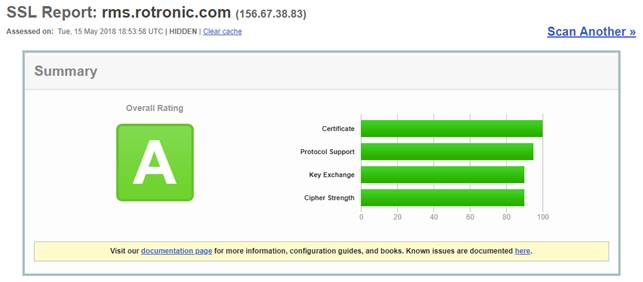
The RMS cloud has an SSL A rating:
For many organizations once end-users approve of a system the challenge is getting the system approved and installed in line with wider corporate policies and security. So far we have found that in discussions with IT project managers and cyber security managers, RMS has met their requirements – usually much to the surprise of the end users who perhaps initially expect a protracted battle!
The RMS software has two core elements:
-
Web service:
-
SQL Database:
The RMS hardware:
- All Rotronic hardware is ethernet based or wireless back to ethernet gateways. Ethernet devices can be powered via PoE, 24VDC and/or batteries, wireless devices are powered either by battery and/or 24VDC. Selected third party devices may require local mains/24VDC power. RMS devices communicate back to the server via port 80. All RMS hardware initiates communication to the server (client-server model). Hardware can be initially configured with IP configuration and server address via RMS-Config software (windows application) or in advance by Rotronic. RMS supports multisite projects and remote servers.
- The wireless devices communicate over 868/915MHz back to an Ethernet Gateway. 868 and 915MHz are low frequency industrial radio bands. We use a proprietary communication protocol and the only information transmitted is the device serial number, time and measured values. All additional data (name, location, owner, alarm conditions etc is stored and used by the server software and associated MS-SQL database).
- A note on RMS hardware; All Rotronic hardware initiates communication with the webservice via port 80. For cloud applications this means only port 80 must be opened outbound to allow the devices to initiate outbound communications to the server. All gateways have standard IP configurations (DHCP or fixed).
- Third party data/device support is possible via RESTful API or direct interaction within the SQL database.
An overview of the RMS communication can be seen here: RMS Communication Overview.
Some other technical points about RMS:
- The on-premise software can be installed on your local servers completely inside your firewall. All functions of RMS can be operated from within your network. Internet access is only required for SMS and Telephone alerts. The RMS software has no issues with automatic updates of the operating system. When the server is offline, the values are stored within the data logger (no alarms are triggered during this time). The data can automatically be sent to the database once the system is up and running again.
- RMS supports LDAP log ins so can utilize existing user names and passwords from your systems.
- Full user rights structures can be created via RMS ensuring selected access and rights for every device, function and user.
- RMS supports optional third party digital data/device/software integration via a JSON API to write data to RMS and read data out. In addition direct interaction with the SQL is possible for third party analytics and reporting. As standard RMS generates PDF and CSV exports via web interface. Data is stored permanently on the SQL database, RMS Enterprise version includes an archive function so inactive devices are archived within the system (all log, event, system data related to archived devices is still on the SQL database and accessible via the archive section of the web software).
- The Web page data is binary coded and authentication uses AES128 encryption, Key exchange uses diffie-hellman key algorithm.
Updated 29.05.2024